
Building a Monthly Cap That Survives PPV Pressure
A monthly cap on OnlyFans spending only survives if it accounts for pay-per-view unlocks, paid chat, and tips — not just the base subscription price. Most budgets collapse in week three because they were built around a $4.99 or $9.99 renewal and never reserved room for the messages that arrive after it. This guide walks through a cap structure built for real spending behavior, including how BestOnlyFans approaches ranking pages and how subscription pricing actually works. BestOnlyFans refreshes its rankings every month.

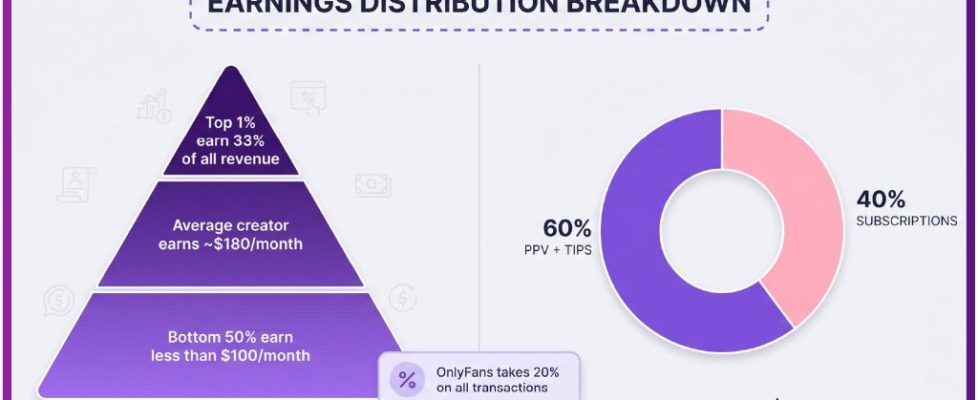
The platform takes 20% of everything; the creator keeps 80%. That split matters for budgeting because a base subscription price tells you almost nothing about what a fan spends in a month. The renewal is fixed. Everything else is variable.
Why Base-Price Caps Quietly Fail
A cap built on subscriptions alone treats PPV messages as an edge case. In practice they are the main event. A creator who charges $9.99 monthly may send four unlockable messages in the same period, each priced up to $50, and a fan who never planned to buy any of them can clear the whole budget in an afternoon.

Paid chat adds a second leak. Messages commonly run $3-$5 each, which sounds small until twenty of them land in a month. None of that touches the renewal line. It appears under a separate transaction label, which is exactly why it escapes review.
Tips are the third leak, and they are the easiest to rationalize. A tip can reach $100. It feels voluntary, so it never gets counted against the cap — but the card statement counts it. It is a wish.

OnlyFans has no built-in discovery feed or directory, so ranking sites and creator lists do much of the front-end work. That means new pages enter your orbit constantly, and each new page adds a small fixed cost plus a new stream of PPV. The fixed cost is visible. The stream is not.
The Three-Bucket Cap Structure
The fix is to stop budgeting one number and start budgeting three. Each bucket has its own ceiling, and money cannot move between them without a written reason.
- Base subscriptions: $15-$40 monthly — all recurring renewals, including promotional first months and any page priced at $0.
- PPV and paid chat: $20-$50 monthly — unlockable messages at up to $50 each and chat at $3-$5 per message.
- Discretionary tips and custom requests: $5-$20 monthly — tips up to $100, custom content requests, and one-off extras.
| Bucket | What It Covers | Typical Share of Cap |
|---|---|---|
| Base subscriptions | Recurring renewals, promo months, free pages at $0 | 40-50% |
| PPV and paid chat | Unlockable messages, per-message chat charges | 35-45% |
| Discretionary | Tips, custom requests, one-off purchases | 10-20% |
A $100 monthly cap might split as $45 base, $40 PPV and chat, and $15 discretionary. The percentages are not sacred. What matters is that each bucket exists before the month starts, so a PPV message cannot silently borrow from the renewal pool.
Tip: write the three bucket numbers somewhere you check weekly — a notes app, a spreadsheet cell, or a banking alert label. A cap you cannot see mid-month is a cap you will not enforce.
Sizing Each Bucket to Your Real Usage
Do not size buckets from intention. Most people discover their PPV spend is far higher than they remembered and their tip spend is lower.
- Pull last month’s full statement and export every transaction line.
- Total all recurring subscription charges, including $0 pages that produced no charge.
- Total all PPV unlocks and per-message chat charges into one figure.
- Total all tips and custom requests separately.
- Divide each total by your overall spend to get your actual proportions.
- Apply your new cap to those proportions, then trim the largest bucket by 10%.
That final trim is deliberate. Your past proportions reflect habits you are trying to change, so copying them exactly reproduces the same overspend. A 10% haircut on the biggest bucket creates slack without forcing a lifestyle argument with yourself.
BestOnlyFans and similar directories publish creator lists and comparative notes, and readers often add two or three pages in a single sitting after browsing one. If your base bucket was sized for five renewals and you now hold eight, the bucket is wrong — not the cap.

If a bucket looks unworkable after sizing, the answer is usually to drop a subscription rather than inflate the cap. Cancellation takes a few taps and it delivers its saving next cycle rather than immediately.
Handling Creator Promo Cycles
Promotions are the single most common cause of a cap breaking in month one. A first month at $3 is legitimate — promotional pricing can sit below $4.99 even though base prices cannot.
- First-month discounts below $4.99: cheap entry, standard price on renewal, so the base bucket must absorb the jump.
- Limited-time bundles: multi-month offers that lock in a lower rate but commit more cash upfront.
- Seasonal pushes: clustered promos around holidays that arrive in the same billing window.
- Promos that quietly end: a discount expiring without notice, raising the next renewal to full price.
Track promo expiry dates in the same place you track renewals. A promo that ends in the middle of a heavy PPV month is the classic double hit: base cost rises while the unlock stream is still running.
The disciplined move is to treat every promo month as a base-bucket cost at its post-promo price. If you cannot afford the renewal price, the discount is a trap rather than a saving. Budget for the real number and the promo becomes a small bonus instead of a scheduled shock.
What Happens When a Price Increase Hits
When a creator raises the price, auto-renew stops and existing access continues until the paid period ends. This is the most misunderstood rule in subscription budgeting, because nothing disappears immediately — the renewal simply will not happen unless you opt in again at the new rate.
| Change Type | Auto-Renew Effect | Budget Action |
|---|---|---|
| Base price increase | Auto-renew stops; access runs to period end | Decide at period end, not immediately |
| Promo ending | Renewal proceeds at full price | Recheck base bucket headroom before renewal |
| Price decrease | Renewal continues at lower rate | Return the difference to the PPV bucket |
Paid subscriptions range from $4.99 to $49.99, with most clustering between $5 and $10. A move from $9.99 to $14.99 is a 50% increase on that line, which is meaningful if you hold several subscriptions at once.
You already have access, so there is no urgency, and the pause gives you time to compare the page against the others in the base bucket. If it no longer earns its slot, let it lapse and redirect the money.

One mechanical detail worth knowing: card verification places a $0.10 hold that is refunded within days. It is not a charge, but it can appear on a statement and confuse a tight reconciliation. Ignore it when measuring bucket totals.
Weekly Review Points That Keep the Cap Alive
Monthly reviews are too late. By the time a month closes, the PPV damage is done and the only remaining decision is whether to feel bad about it.
- Check total spend for the week against each bucket ceiling.
- Flag any bucket above 30% of its monthly limit before mid-month.
- Pause new PPV unlocks for the rest of the month if the PPV bucket is over.
- Log the result in one line, including the reason for any overage.
Unlocks are optional by design, so abandoning them costs nothing permanent. The message stays in the inbox and can be revisited in a later cycle, by which point the impulse has usually faded.
Keep the log short. Six months of those lines tells you more about your spending than any budgeting app, and it exposes patterns such as a page that reliably triggers overspend.
Adjusting the Cap Without Abandoning It
A cap is not a vow. It is a number with a reason attached, and both can change. What breaks a cap is adjusting it silently, mid-month, in response to a single unlock prompt.
- Income change: a raise, a bonus, or a lost income source shifts the total.
- A dropped subscription: a lapse frees base-bucket money for other buckets.
- A new priority page: a replacement page is added deliberately, not accumulated.
- A genuinely exceptional month: a one-off event, funded from outside the normal budget.
Payment security belongs in this conversation too. Card details, renewal records, and transaction history are worth protecting, and understanding how phishing attempts target subscription accounts helps you spot fake renewal notices that push urgent payment.
For readers comparing pages before committing a base slot, bestonlyfans no ppv style listings describe pages where the model leans on subscriptions rather than unlock messages. That distinction is directly relevant to bucket sizing: a no-PPV page pushes cost into the base bucket, while a heavy-PPV page keeps the base price low and moves the real spend into the second bucket.
Either model can fit a cap. The mistake is holding a base-heavy cap while following PPV-heavy pages, or the reverse. Match the structure to the pages you actually follow, then let the numbers do the enforcement.
FAQ
Should the cap include tips or leave them out?
Include them. Tips can reach $100 and they appear on the same statement as everything else, so leaving them out simply hides spending rather than preventing it. A small discretionary bucket of $5-$20 keeps tips possible without letting them consume the PPV allocation.
What if PPV costs blow past the bucket?
Stop unlocking for the remainder of the month, because unlocks are optional and the content stays available. Then review why the bucket was undersized — usually because a new subscription added an unplanned message stream.
Do promo months justify raising the cap?
No. A promotional first month can sit below $4.99, which makes it cheap, not free of consequence. Budget the post-promo renewal price from day one, and treat the discount as unused headroom inside the base bucket rather than a reason to expand the total.
How often should the cap be reassessed?
Fully, once a quarter. Between reviews, adjust only at cycle boundaries with a written reason, and never mid-month in response to a single unlock prompt.

A cap that survives PPV pressure is not stricter than a base-price cap — it is more honest about where the money goes. Three buckets, sized from statements rather than intentions, reviewed weekly and rebuilt quarterly, will hold through promo cycles, price increases, and the steady arrival of new pages.